GIFT City Funds
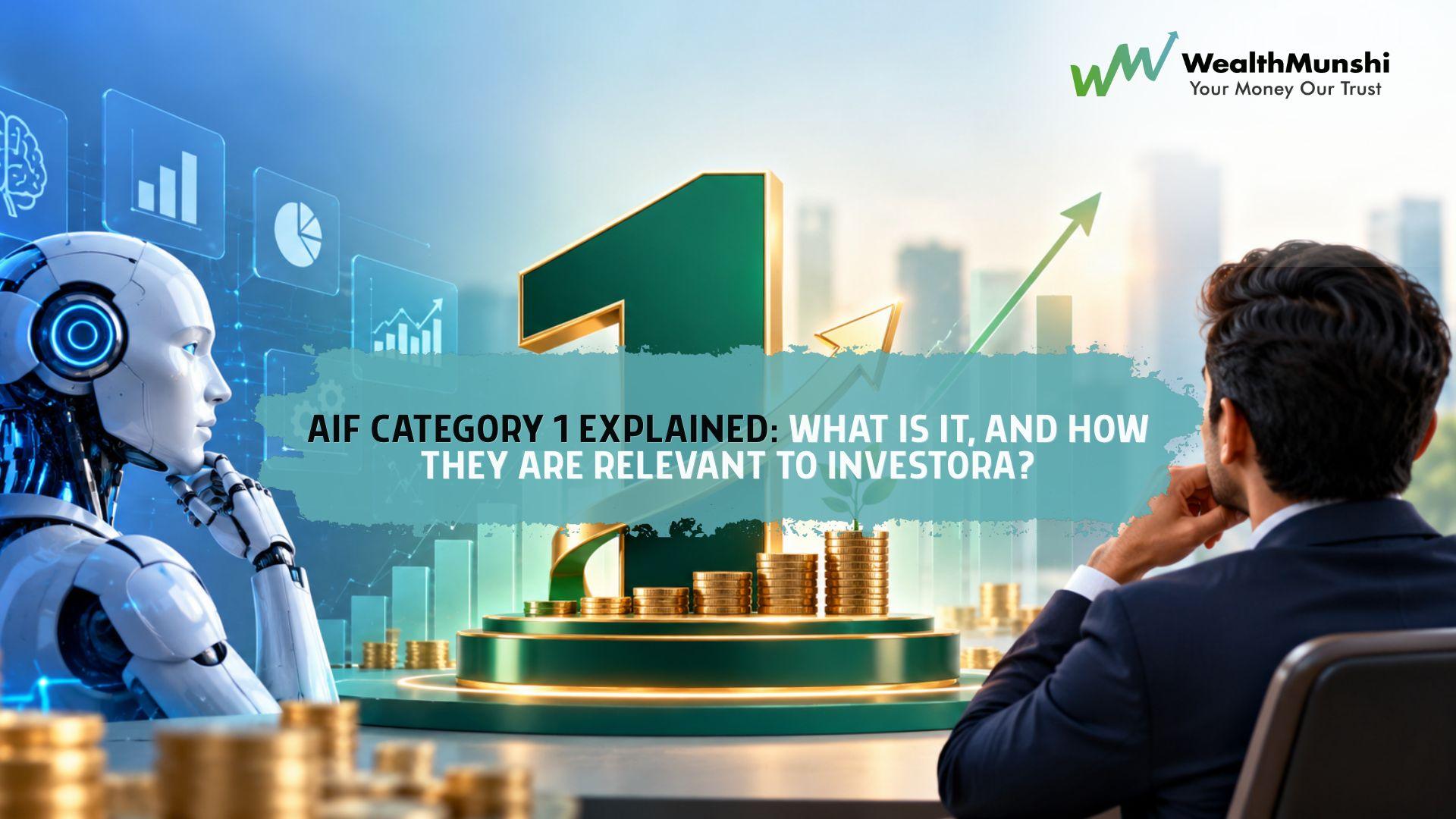
The category is defined by what it may invest in, not by a performance label. Category 1 aif targets start-ups, SMEs, social ventures, and infrastructure under SEBI rules.
Quick Answer Box
Category I AIFs invest primarily in unlisted early-stage, SME, social, or infrastructure assets. They are closed-ended. The minimum investment is usually ₹1 crore. Taxation is generally passed through. They are distinct from Category II (broader private markets) and Category III (trading strategies). There is no official best platform/manager list
What Category 1 Is
Category 1 aif in India are registered under the SEBI (Alternative Investment Funds) Regulations, 2012. Its investment focus is on:
- Venture capital / start-ups and early-stage companies
- SMEs
- Social enterprises
- Infrastructure *
- Other areas deemed desirable for economic or social development by the regulations or the government
The sub-categories identified are Venture Capital Funds, SME Funds, Social Venture Funds, Infrastructure Funds, and Angel Funds. Angel funds have different corpus and ticket sizes and additional rules (including accredited-investor requirements in recent frameworks).
Category 1 2 3 aif different purposes:
- Category I: the above developmental/early-stage/infrastructure set.
- Category II: A catch-all category for private equity, private credit, real estate, and like strategies that do not qualify for Category I incentives and are not Category III.
- Category III: funds that employ diversified or complex trading strategies, including in listed securities and may employ leverage.
Difference between category 1 and 2 aif:
Category I has a more restricted investment universe and often receives certain regulatory or tax treatment linked to its developmental purpose. Category II is the broader private-market residual. Both are normally closed-end and both generally enjoy pass-through taxation. Category I typically cannot use leverage for investment purposes; Category II may borrow within limits.
Can aif invest in listed companies?
Category I schemes must deploy a large portion of the corpus (commonly two-thirds or more, subject to the exact regulation and subcategory) in unlisted securities of the permitted type. Limited holdings of listed securities may be possible under the scheme documents and SEBI limits, but listed-market trading is not the core activity. That role belongs mainly to Category III.
Who can invest in aif? and Minimums
Resident individuals, Hindu Undivided Families, NRIs, companies, LLPs, trusts, and institutions are subject to the minimum investment and any scheme-specific eligibility (including accredited-investor rules wherever applicable).
Categories I, II & III have an ordinary minimum investment of ₹1 crore per investor. Exceptions are
- AIF employees or directors, managers, or sponsors: Rs. 25 lakh.
- Angel Funds: different or lower thresholds.
- Higher tickets for large value funds (recently reduced in some cases).
- The SEBI criteria (updated in the 2025–2026 amendments, in terms of net worth, income, or securities-market exposure routes) may give more flexibility to accredited investors.
Thus, Category 1 AIFs with low minimum investment requirements are limited. The statutory ₹1 crore floor (or Angel Fund exception) applies to ordinary investors. There is no “low-minimum Category I” product running wild that ignores the regulation.
How to invest in category 1 AIFs through online portals?
Usually subscription is by private placement. The manager issues a private placement memorandum. PPM and contribution agreement followed by commitment and draw-downs. AIFs are listed on some distributors or wealth platforms, but the legal relationship is between the SEBI-registered AIF and its manager. A typical close-ended Category I scheme has no exchange-traded ‘buy button,’ unlike a mutual fund SIP.
Best platforms offering category 1 AIFs for investors in India. Where can I find reviews of category 1 AIF managers in India?
SEBI publishes the list of registered AIFs The PPM discloses the track record, team, and strategy of the managers. Independent data sites and wealth platforms may display committed capital or prior schemes. There is no SEBI ranking of “best” Category I platforms or managers. Past performance is no guaranty. The investor remains responsible for due diligence on the manager, investment thesis, fees, governance, and liquidity terms.
Taxation
Cat 1 AIF taxation: Category I (and Category II) AIFs are generally treated as pass-through vehicles. Income (capital gains, dividends, interest, etc.) retains its character and is taxed in the hands of the investor. Business income is an important exception and can be taxed at the fund level. Distributions may attract TDS. Category III is taxed at the fund level. Exact rates follow the character of the income and the investor’s status (resident, NRI, etc.) under the current Income Tax Act. Confirm the year’s rules and the fund’s reporting before filing.
Financial & Technical Data Matrix – Category I Essentials
| Feature | Category I position |
| Focus | Start-ups, SME, social, infrastructure |
| Structure | Close-ended |
| Leverage for investment | Generally not permitted |
| Min. investment (ordinary) | ₹1 crore |
| Tax | Generally pass-through |
| Listed-company core | No |
| Official best manager | None |
Risk Analysis: Eleven Category I Errors
- Treating Category I as a listed-equity product.
- Expecting a minimum below ₹1 crore for an ordinary investor.
- Assuming open-ended liquidity.
- Ignoring that leverage for investment is restricted.
- Ranking “best” managers from an advertisement.
- Forgetting pass-through means the investor still pays tax on the character of income.
- Confusing Angel Fund rules with ordinary Category I rules.
- Overlooking the long lock-in and draw-down schedule.
- Assuming every online portal is a SEBI-registered AIF.
- NRIs ignoring FEMA and tax-residency effects on AIF income.
- Using past IRR as a forecast.
Generic Advice vs. Strategic Thinking Matrix
| Decision Point | Generic Advice | Strategic Thinking |
| What it is | “High-return fund” | Developmental / early-stage focus under SEBI |
| Minimum | “Some are low” | ₹1 crore ordinary; check Angel exceptions |
| Tax | “Fund pays” | Pass-through (with business-income exception) |
| How to buy | “Any app” | PPM + contribution agreement with registered AIF |
| Reviews | “Best list” | SEBI registration + PPM due diligence |
Strategic thinking reads the investment restrictions and the ticket size before the marketing return.
Closing Perspective
A Category I AIF is an SEBI-registered vehicle for startups, SMEs, social ventures and infrastructure. It is close-ended. Typically pass through for tax. Usually needs ₹1 crore. It is not like Category II and Category III. This is not a primary listed equity product. There is no official best manager or platform. The subscription is in PPM of a registered fund.
This is general information and not an offer of units or a recommendation to invest in any AIF.
People Also Ask
Q.1 What is a Category I AIF?
A SEBI-registered AIF that invests in start-ups, early-stage ventures, SMEs, social ventures, or infrastructure.
Q.2 Who can invest?
Individuals, HUFs, NRIs, companies, and institutions that meet the minimum investment and any scheme eligibility.
Q.3 What is the minimum investment?
Ordinarily ₹1 crore. Lower amounts apply to employees/directors and to Angel Funds under their rules.
Q.4 Can a Category I AIF invest in listed companies?
Its core mandate is unlisted securities of the permitted type. Substantial listed trading is not the purpose.
Q.5 How is it taxed?
Generally pass-through: income keeps its character and is taxed in the investor’s hands (business income is an exception).
Q.6 How do I invest through online portals?
You can invest through the PPM and contribution process of a SEBI-registered AIF. Platforms may distribute; the fund remains the legal vehicle.
Q.7 Are there low-minimum Category I AIFs?
Only within the statutory exceptions (employees, angel funds). The ordinary floor is ₹1 crore.
Q.8 How can WealthMunshi help?
WealthMunshi provides private-wealth and tax-planning context on whether an AIF allocation fits, not as an AIF manager or a ranking service.
Category I exposure is long-dated, illiquid, and ticket-size constrained. Readers evaluating a specific PPM can schedule a fit, fee, and tax-character review before signing a contribution agreement.